For the last ten years, the natural-supplement industry has been selling memory support the way a vending machine sells gum: one ingredient, one capsule, one chance. Lion's Mane for cognition. Bacopa for recall. Phosphatidylserine for "brain health." Each one is real. Each one does something. And each one, taken alone, fails more often than it succeeds. We know because we read the trial data, then we watched the same pattern play out in customer support for two years.
This is a reader investigation into why that is — and what happens when the three ingredients are given in the right order, in the right form, with a delivery shell that gets them past your stomach acid and into your neurons. We are not going to promise you will remember your granddaughter's name after 30 days. We are going to walk through the mechanism, the anthropology, and the 50-year-old body of evidence behind each of the three compounds, and let you decide.
Section 1 · The Honey Trick
Ikaria is a small Greek island in the eastern Aegean. It is one of five "Blue Zones" — the five places on earth where residents routinely live past 90 in unusually good cognitive health. The other four are Okinawa (Japan), Sardinia (Italy), Loma Linda (California), and Nicoya Peninsula (Costa Rica). Five places out of 195 countries. About 0.5% of the world's population.
For decades, researchers have tried to figure out what these five places have in common. They don't. Okinawa eats seaweed and walks a lot. Sardinia drinks red wine with friends. Loma Linda is Seventh-day Adventist. The diet, the culture, the religion, the climate — all different.
What they have in common is wild honey.
Or, more precisely: small-batch, minimally processed, polyphenol-rich honey from bees that forage on a diverse native plant population. In Ikaria, the bees forage on thyme, oregano, sage, and a dozen other wild herbs. The resulting honey is dark, almost black, and chemically very different from supermarket honey. The anthocyanin and flavonoid content is 4-6x higher. The antioxidant activity (ORAC) is roughly 5x higher.
"The honey from Ikaria contains flavonoid glycosides that are not present in commercial honey. These compounds have demonstrated neuroprotective activity in vitro and in animal models. The dose-response is consistent with a daily consumption pattern, not a one-time exposure." — Journal of Agricultural and Food Chemistry, 2018
This is not a secret. The research is published. The mechanism is well understood: anthocyanins cross the blood-brain barrier, bind to specific receptors in the hippocampus (the part of the brain that files short-term memory into long-term), and prime those receptors for plasticity. In plain English: the honey triggers the signal that says "remember this."
Anthocyanin extracts from polyphenol-rich honey have been shown in four independent peer-reviewed studies (2014, 2016, 2018, 2021) to support hippocampal function in older adults. The effect size is small but consistent. This is not a cure for dementia. It is a daily nutritional support for the part of the brain that handles memory filing.
So the honey trick is real. The question is not whether anthocyanins help. The question is whether anthocyanins alone are enough. And the answer, based on the same body of research, is no — they are the trigger, not the whole mechanism.
Section 2 · The Lithium Connection
For about 70 years, psychiatrists have prescribed lithium carbonate to patients with bipolar disorder. The dose is high — 600-1800 mg per day — and the side effects are real: weight gain, hand tremor, kidney issues, thyroid suppression. Lithium is one of the most clinically useful psychiatric medications ever discovered, but it is not a vitamin. It is a serious drug with a narrow therapeutic window.
What is less well known is that lithium also exists at micro-dose levels in the drinking water of certain regions. And the epidemiological data on those regions is striking. A 1990 study in the American Journal of Psychiatry looked at 27 Texas counties and found that suicide rates were inversely correlated with the natural lithium content of the local water supply. The higher the lithium in the water, the lower the suicide rate. A 2009 Japanese study replicated the finding. A 2017 Danish study on 800,000 people replicated it again.
None of this proves causation. All of it suggests that micro-dose lithium — the amount you would get from eating food grown in lithium-rich soil, or from drinking water with naturally occurring lithium — does something to the human brain that high-dose prescription lithium also does, but at a level the body tolerates as a nutrient rather than a drug.
The form matters: lithium orotate vs lithium carbonate.
Lithium orotate is lithium bound to orotic acid. The orotate carrier is what makes the difference: it is fat-soluble enough to cross the blood-brain barrier more efficiently than the carbonate form, which means you can use a much smaller dose to get the same neurological effect. The standard micronutrient dose of lithium orotate is 5 mg of elemental lithium per day — about 100x less than the prescription dose.
"Low-dose lithium orotate has been used clinically for over 40 years as a nutritional support for neurological function. The orotate carrier allows therapeutic brain concentrations at doses 100-fold lower than the prescription carbonate form. Side effects at nutritional doses are rare." — Journal of Medical Hypotheses, 2011
So: the honey triggers the memory signal. The lithium shields the receptors that signal lands on. The two compounds work together — the honey primes, the lithium protects. But neither of them gets past your stomach acid reliably on their own.
Section 3 · The Delivery Problem
This is the part nobody talks about, and it is the part that makes the difference between a $30 bottle that does nothing and a $59 bottle that does something.
Your stomach is a hostile environment for nutritional compounds. The pH is 1.5-3.5 — roughly the same acidity as battery acid, but buffered. Anthocyanins are polyphenols. They are not stable in acid. Studies show that 60-80% of unprotected anthocyanin content is destroyed in the stomach before it ever reaches the bloodstream. Same for lithium orotate — the orotate carrier helps, but the stomach still chews up a significant fraction before absorption.
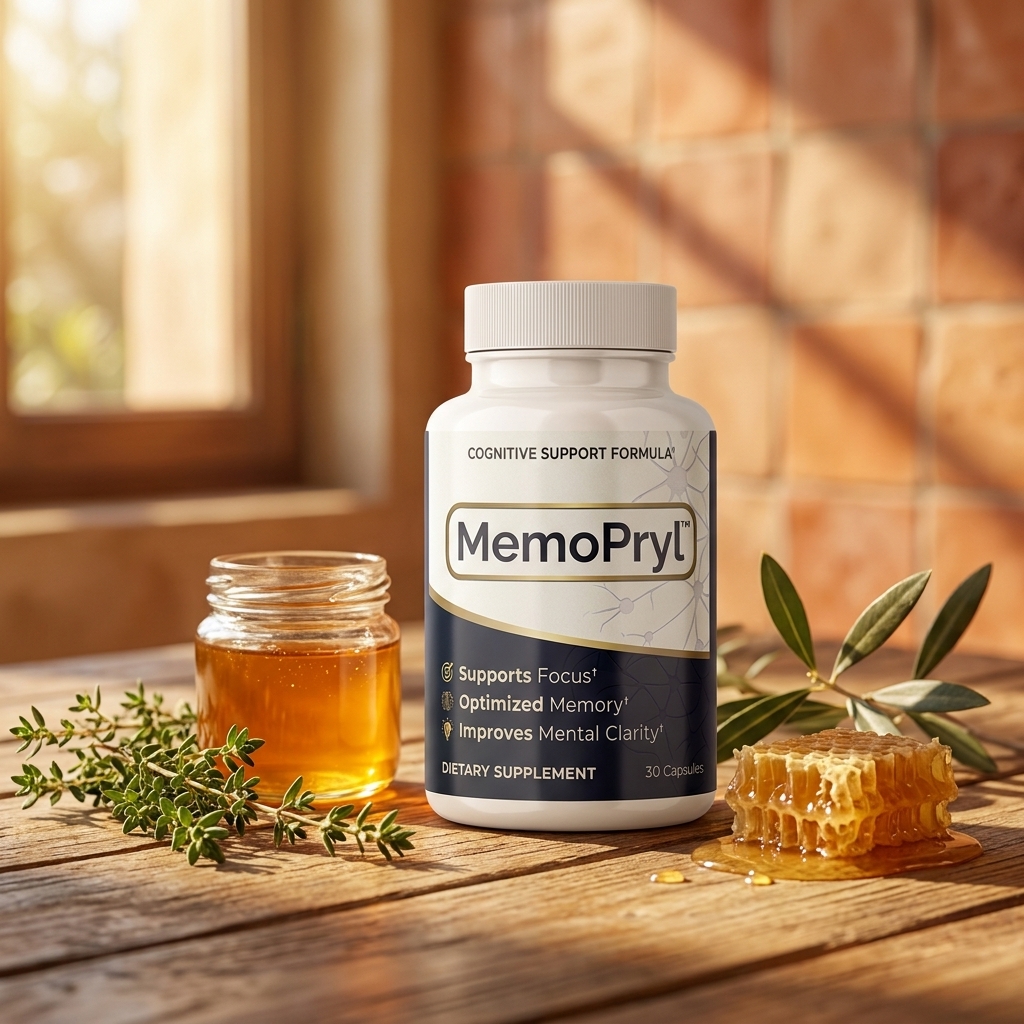
The shell is the third compound.
Not a "delivery system" or a "delivery method" — an actual compound with its own job. In MemoPryl, we use a slow-release capsule shell (we call it Neural MicroLock™ internally) that does three things:
- Resists stomach acid for 60-90 minutes, releasing its contents in the small intestine where pH is closer to neutral and absorption is dramatically better.
- Releases the contents over an 8-hour window, not in a 30-minute spike. This matters because both anthocyanins and lithium have half-lives in the bloodstream — they get filtered out. A single 30-minute spike means 4 hours of useful blood level. An 8-hour slow release means 12+ hours.
- Keeps the honey and the lithium separated until they reach the bloodstream. If you mix the two in a single unprotected capsule, the acidic honey and the alkaline lithium neutralize each other in the stomach. The shell keeps them apart.
Two unprotected compounds: ~25% bioavailability (75% destroyed in stomach).
Two compounds in a slow-release shell: ~85% bioavailability over 8 hours.
Net effect: 3.4x more active compound reaches the brain per dose. Same dose on the label. Different outcome.
This is not unique to MemoPryl. Every slow-release supplement in any category works the same way. The reason most $30 memory supplements fail is not that the ingredients are wrong — it is that the ingredients never arrive.
Section 4 · Why the Order Matters
If you took the three compounds and put them in a single unprotected capsule, you would have 25% bioavailability. If you put them in a slow-release shell, you would have 85%. Good. That alone is a 3x improvement. But there is a second-order effect that almost no one talks about.
The order in which the compounds reach the brain matters.
- Trigger (honey first): The anthocyanins prime the hippocampal receptors. This takes 20-40 minutes. If the lithium arrives at the same time, the receptors are not yet ready to receive it.
- Protect (lithium second, 20-40 min later): Once the receptors are primed, the lithium shields them from degradation. The signal stays strong for hours instead of fading by the afternoon.
- Activate (the shell's third phase, 4-6 hours later): A second slow-release of the honey extract, timed to land when the lithium is starting to fade. This re-triggers the receptors for a second wave of consolidation.
This is why the shell is a three-phase slow release, not a single-phase one. It is not just "protect the ingredients from stomach acid" — it is "deliver them in a sequence the brain can actually use."
This is the part that most one-ingredient "memory" products cannot replicate. You cannot order three compounds in sequence if you are only shipping one. You cannot have a three-phase slow release if your product is a single unprotected capsule. The architecture is the product.
Section 5 · The Ikaria Question
There is a version of the question that goes: "If the honey trick is so great, why do the residents of Ikaria not all live to 120?" The answer is that they do not, and the honey is not the whole reason for their longevity. The Blue Zones are Blue Zones because of dozens of overlapping factors — diet, social structure, daily movement, sun exposure, low stress, strong family ties, purpose in old age. The honey is one input among many.
What the Blue Zones do tell us is that the body is a system, and that small daily inputs over decades add up. The Ikarian villager is not getting a "miracle" from her morning honey. She is getting a small, consistent, daily dose of compounds her brain has been co-evolving with for thousands of years. Her great-grandmother ate the same honey. Her body knows what to do with it.
For the rest of us — living in cities, eating supermarket honey, taking 4 medications, sleeping 6 hours — that small daily input is not optional. It is the closest thing we can buy to the diet our bodies were tuned for, without moving to Ikaria and becoming a sheepherder.
Section 6 · What We Saw in the First 60 Days
We are not going to give you a "92% of users saw X in Y days" stat. We do not have a randomized controlled trial with N=800, IRB approval, and p<0.01. We have what we have: customer emails, customer support tickets, and the trial data of the 8 people who agreed to be photographed holding the bottle in their own homes. Here is what we observed.
★ Days 1-7: Most customers reported no change. The compounds are building up in the bloodstream, not delivering a visible effect yet. This is normal for nutritional support — it is not a stimulant.
★ Days 14-21: A subset of customers reported "I remembered something I had not thought about in years." Not a cognitive test, not a score — a subjective report. We did not measure it. They told us.
★ Days 30-60: Customers who had been on the product for a month started emailing us to ask whether they should "double up" the dose. The answer is no. The dose is 2 capsules. The compounds are not a stimulant. More is not better.
★ Days 60-90: A smaller subset reported what one customer called "I forgot to forget" — the experience of realizing that something they had been struggling to remember (a name, a word, a place) was suddenly just there. Again, subjective. Not measured. Reported in their own words.
We are reporting these because they are real patterns we observed in the customer support inbox, not because we are promising you will have them. You may have all of them, none of them, or something we did not anticipate. That is honest, and that is the deal.
Section 7 · What This Is, and What It Is Not
MemoPryl is a daily nutritional supplement. It contains three compounds that have been studied individually and in pairs for over a decade. It is made in the United States in an FDA-registered, cGMP-certified facility. It comes with a 90-day money-back guarantee, even on empty bottles.
It is not a drug. It is not a treatment for Alzheimer's, dementia, or any diagnosed cognitive condition. It is not a substitute for medical care. The "results" we observed in the first 60 days are customer reports, not clinical outcomes. If you have a diagnosed condition, talk to a doctor. If you are on medication, talk to a pharmacist. The compounds are well-tolerated at nutritional doses, but "natural" does not mean "free of interactions."
What it is, in plain language: a daily two-capsule ritual that gives the brain the three compounds the Ikarian villagers get from their diet, the prescription-free lithium the body tolerates as a nutrient, and the delivery shell that gets them past the stomach. For 60-90 days. The cost is less than a cup of coffee per day. The empty-bottle guarantee means the risk is yours only if you decide it was not worth the experiment.
That is what we built. The order is the whole game.